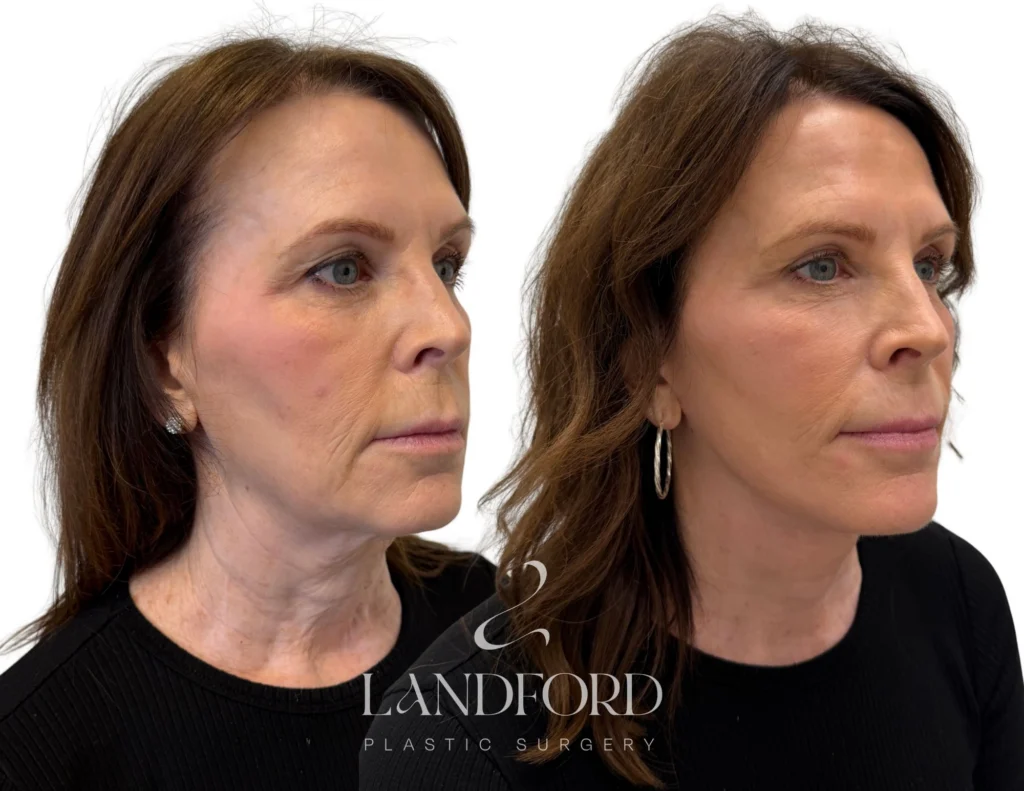
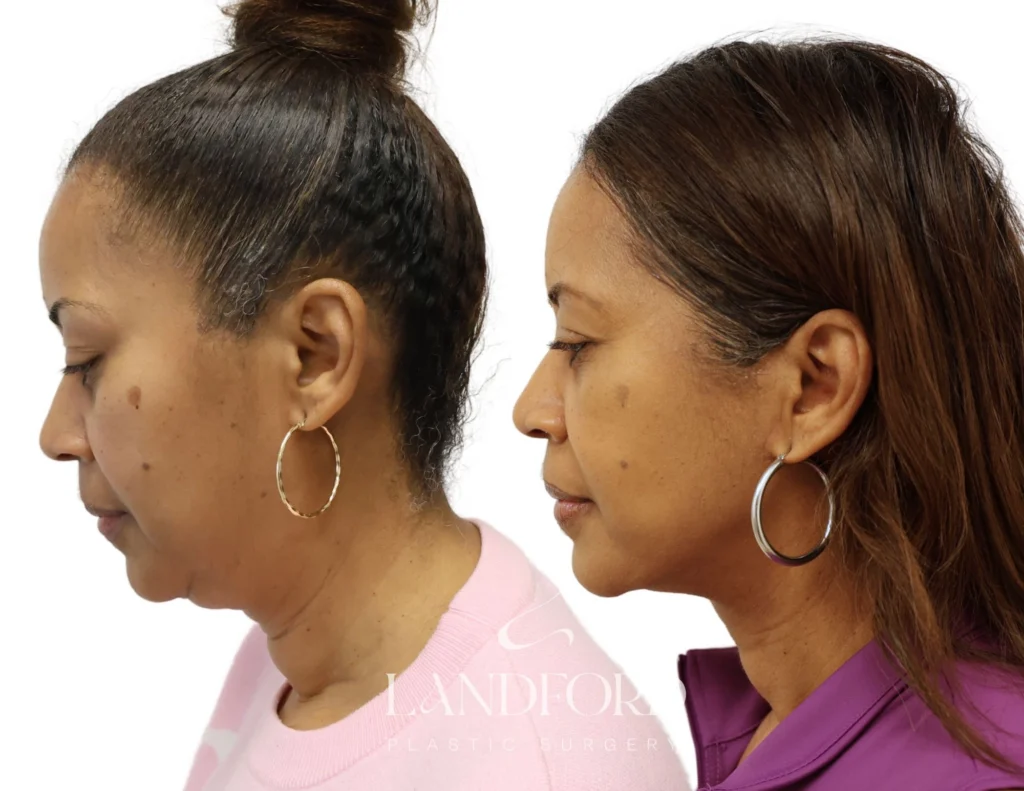
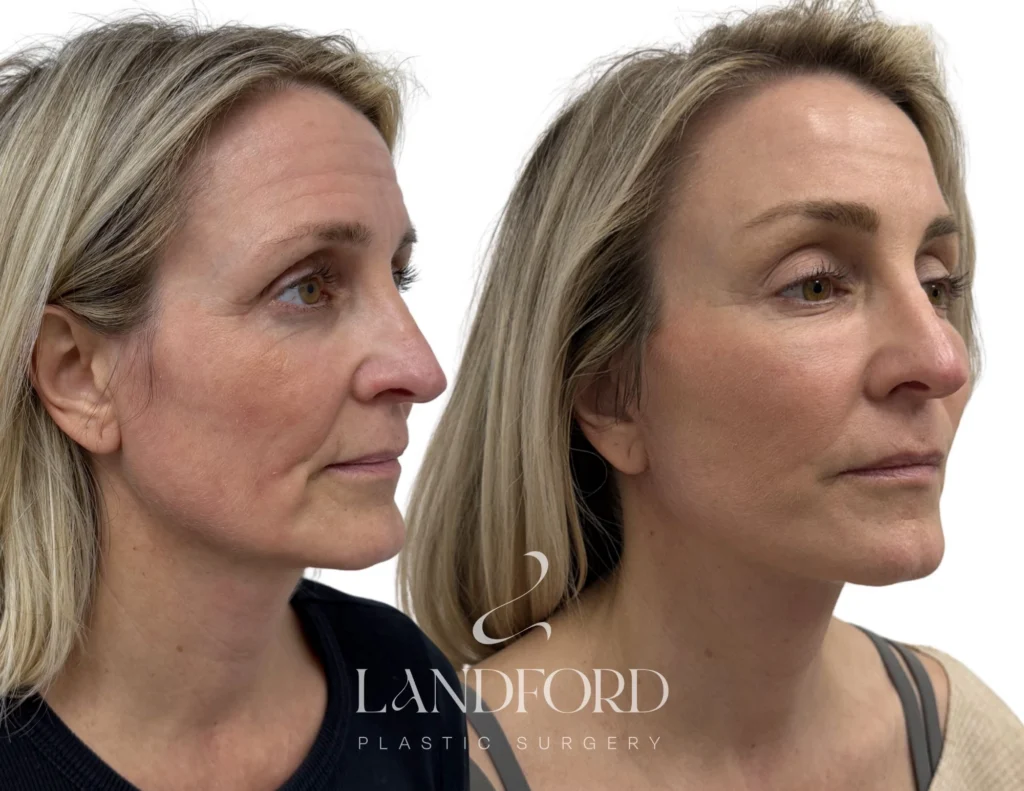
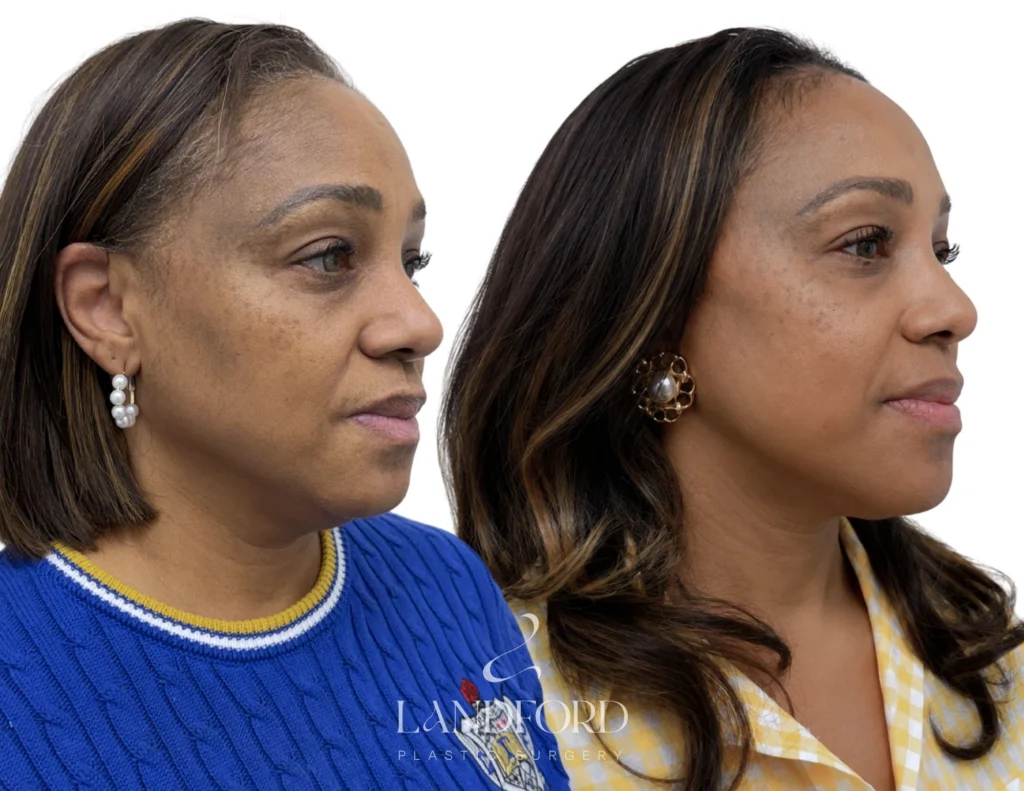
Deep Plane Facelift
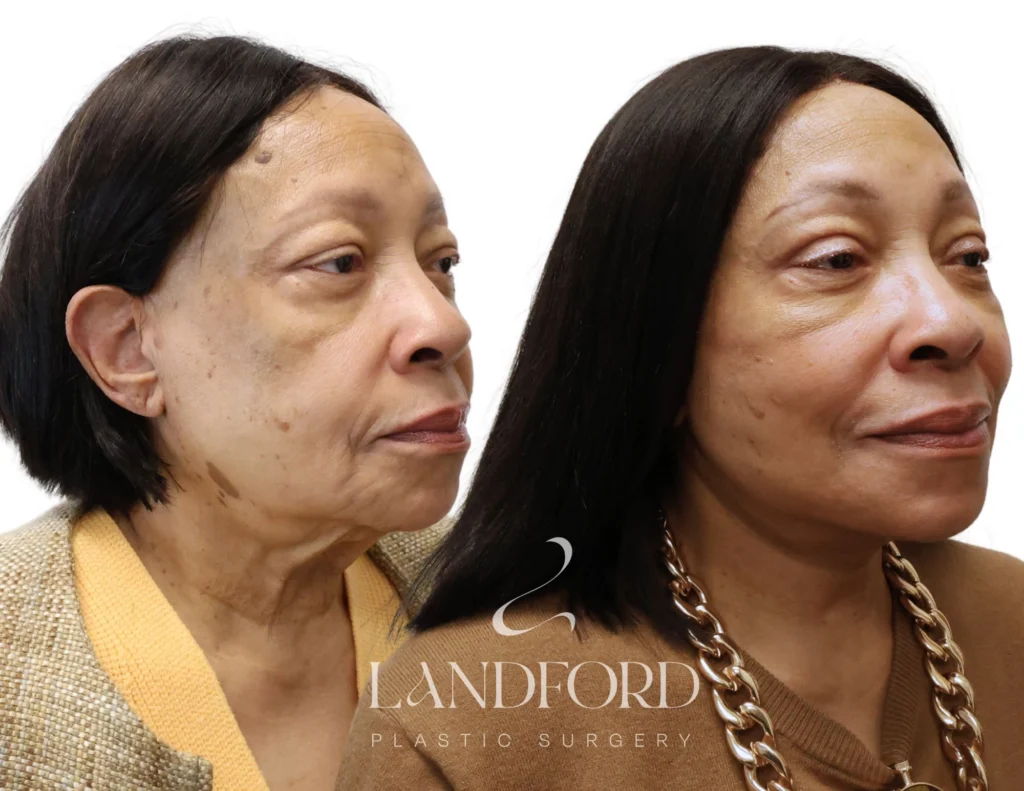
Considered the most invasive technique, deep plane facelift surgery produces the longest-lasting results, with many patients seeing results lasting up to 15 years. Patients will have a successful flattening of the nasolabial fold (a.k.a. the “Smile lines” or “Laugh lines”) with an additional target to the mid-face region, reaching deep tissues and the deeper layers of facial muscle.
After you’ve been administered intravenous sedation with local anesthesia, Dr. Landford will mark the locations on your skin where she intends to make the incisions around the hairline and ears. She will then tighten and secure the layer of connective tissue and underlying muscle beneath your skin, releasing strategic ligaments at a deeper level to lift and rejuvenate your appearance, and repositioning the underlying layer of muscle and tissue. Once she is finished, Dr. Landford will carefully close the incisions.
During the initial three weeks of your recovery, there will be significant bruising, swelling, and discomfort. You will need to continuously wear a compression garment and neck support during the first few weeks, or until Dr. Landford removes them.
You will need to avoid working for the first two weeks so you can recover comfortably, and avoid any strenuous activity for six weeks. It is not uncommon to see ongoing swelling or bruising for longer than a year, but if you have any concerns, please don’t hesitate to contact our office.
Mini Facelift
The Mini Facelift is a slightly modified version of a traditional facelift and helps minimize loose skin around the lower portion of your face. Most plastic surgeons consider mini facelifts to be less invasive and require less skin removal than other facial surgeries.
Dr. Landford will make discreet incisions behind your ears that are easily hidden once healed. Using the incision, your skin and facial muscles are carefully tightened, and any excess tissue is removed. Your incisions are then closed with a precision suturing technique that reduces tension on your skin and minimizes visible scarring.
This surgery usually lasts less than two hours. You can expect to experience some mild swelling and bruising, but a mini lift has a much less intense recovery than traditional full facelift surgery.
Mid-Facelift
This technique uses small incisions around the hairline and ear, which allow Dr. Landford to tighten and smooth out the underlying tissue and muscles. She will also elevate your cheek fat pads (clinically referred to as malar pads) to create a more elevated cheekbone appearance. Once the fat pads are placed into a suitable position, the incisions are sutured and closed.
This procedure will take about two hours, and most patients can see their final results within two or three months. During the initial stages of recovery, your cheeks may be very defined; they should gradually settle into a more natural position over time.
Awake Facelift
This form of surgery involves local anesthesia to numb the patient during surgery. However, oral sedation can also be used to help you relax through the procedure. When performing an Awake Facelift, Dr. Landford avoids some of the medical complications and unpleasant side effects that general anesthesia or heavy sedation can cause in some patients, such as nausea. Wide awake surgery allows Dr. Landford to take her time for optimum results as she improves your facial appearance.
An awake facelift also has minimal bleeding, which creates a lower chance of nerve injury since your tissue will not be stained; clean tissue allows Dr. Landford to work efficiently and avoid cutting nerves during surgery. In traditional facelift methods, nerves and connective tissues are hard to discern, and surgeons can make mistakes. This precise method of surgery allows her to sculpt your face artfully for your best results. The remaining skin is repositioned rather than being pulled, like in a traditional facelift. This allows your skin to be fully mobilized and repositioned to accent the natural angles of your face.
Facial Fat Grafting
Dr. Landford strategically places these purified fat cells in layers to restore contour in the cheeks, temples, jawline, and under-eye region. This precise placement allows her to sculpt natural definition while maintaining balance and facial harmony. In addition to restoring youthful fullness, fat grafting introduces living regenerative cells that integrate with surrounding tissue, improve skin quality, and support long-term structural rejuvenation.
Platelet-Rich Plasma (PRP)
Platelet-rich plasma (PRP) therapy harnesses concentrated growth factors derived from your own blood to stimulate collagen production and support tissue regeneration. During your facelift procedure, a small blood sample is drawn and centrifuged to isolate platelet-rich plasma. This highly concentrated serum contains natural growth factors that promote healing and cellular renewal.
Dr. Landford may apply PRP directly to surgical sites or strategically inject it into targeted regions of the face to enhance recovery and improve skin quality. By stimulating collagen and supporting circulation at a cellular level, PRP helps refine texture, improve tone, and encourage healthier, more resilient skin. When combined with structural lifting and fat grafting, this regenerative therapy supports smoother healing and contributes to more vibrant, long-lasting results.