Awake Facelift
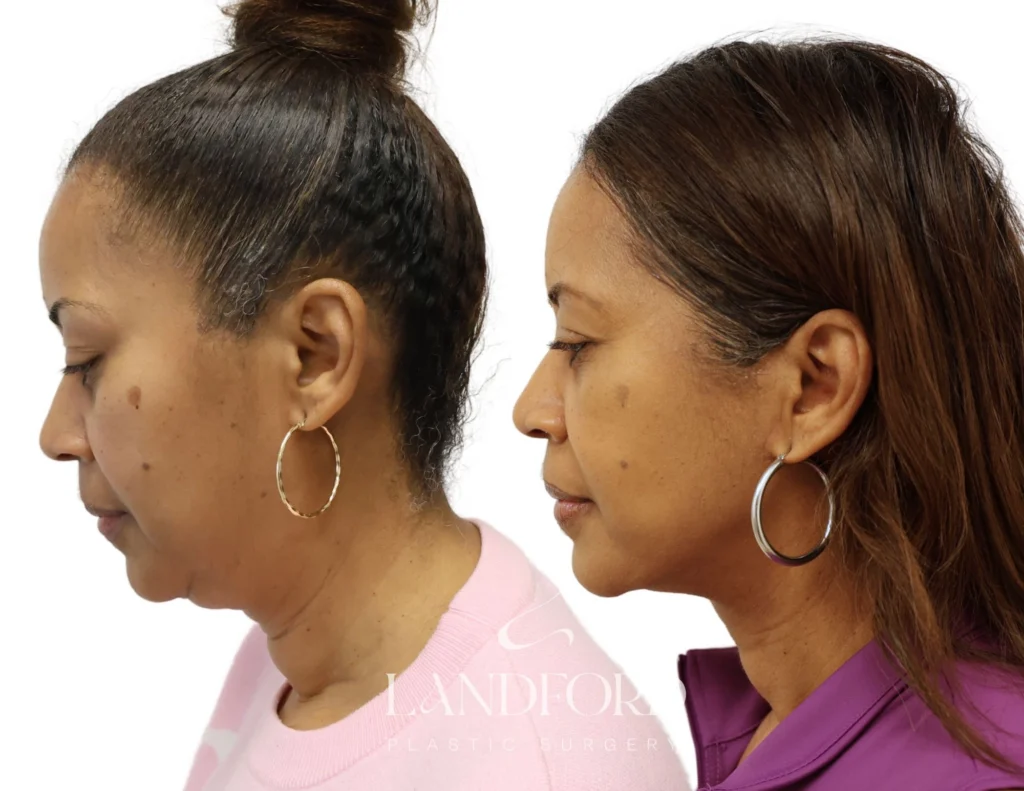
This technique uses local anesthesia to numb the patient during the surgery. Oral sedation may also be used to help patients feel more comfortable throughout the procedure. During an awake facelift, Dr. Landford minimizes the complications and side effects associated with general anesthesia or heavy sedation, such as nausea and fatigue. When patients are wide awake, Dr. Landford can take her time and ensure even more optimal results.
An awake facelift involves less bleeding, reducing the risk of nerve injury. Clean tissue allows Dr. Landford to work more efficiently and with a lower risk of cutting nerves during the procedure. In a traditional facelift, it can be difficult to distinguish nerves from connective tissue, and the surgeon can make mistakes. An awake facelift allows Dr. Landford to sculpt your face with enhanced accuracy for optimal results. Instead of being pulled, the remaining skin is repositioned, similar to a traditional facelift. This fully mobilizes your skin and repositions the accent of the natural angles of your face.
Deep Plane Facelift
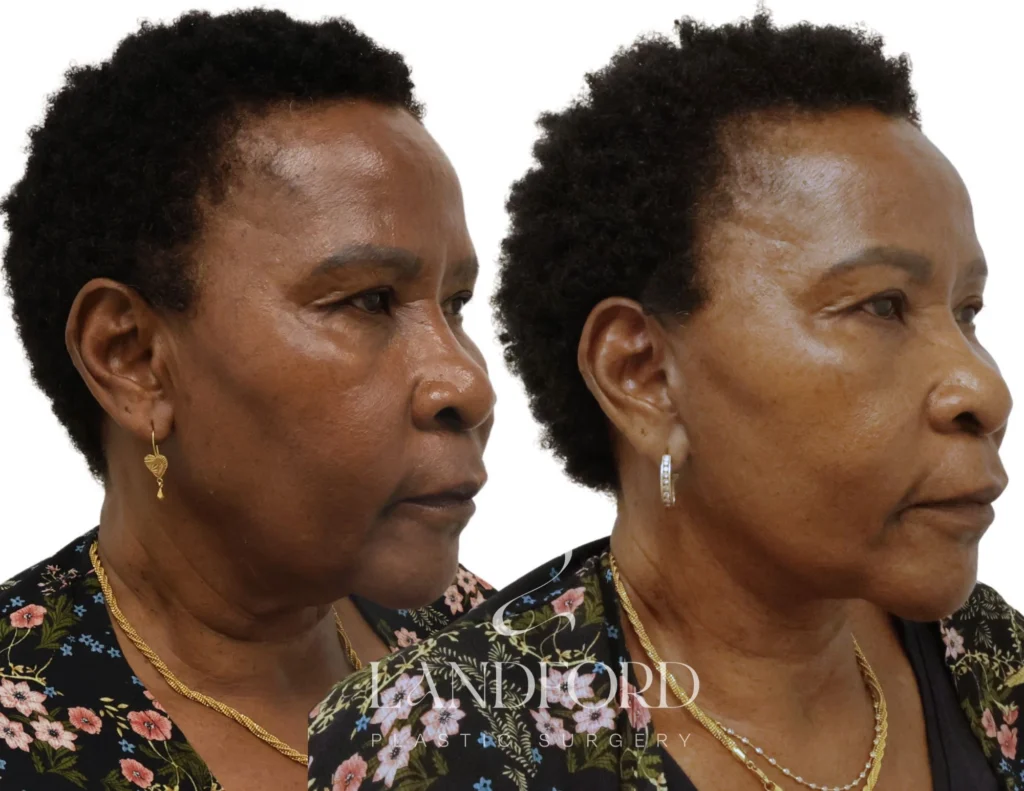
This technique is considered the most invasive and complex facelift technique, producing the longest-lasting results, lasting up to 15 years. It flattens the nasolabial fold (a.k.a. the “smile lines” or “laugh lines”) and targets the mid-face region, reaching deep facial tissues and deeper layers of facial muscle to produce incredible anti-aging results.
Deep plane facelift utilizes intravenous sedation with local or general anesthesia. To begin the surgery, Dr. Landford will mark the locations on your skin where she will create the incisions, typically around the hairline and ears. She will tighten and secure the layer of connective tissue and underlying muscle under your skin, releasing strategic ligaments at a deeper level to lift and restore your youthful appearance and reposition the underlying layer of muscle and tissue. When this is complete, Dr. Landford will carefully close the incisions with sutures.
During the first few weeks of your recovery, your face and neck will have significant bruising and swelling, which will be quite uncomfortable. Dr. Landford will give you a compression garment and neck support, so make sure to wear them at all times, except when bathing, until Dr. Landford removes them.
You won’t be able to work for the first couple of weeks so that you can prioritize your safety, comfort, and healing. Avoid strenuous activity for six weeks. It’s possible for swelling or bruising to persist for over a year, but you can always reach out if you have any concerns or questions.
Mid-Facelift
In this technique, Dr. Landford uses small incisions around the hairline and the ear, allowing her to tighten and smooth the underlying tissue and muscles. She will also elevate your cheek fat pads (malar pads) to further produce an elevated cheekbone appearance. When the fat pads have been placed into a suitable position, the incisions are sutured and closed.
This procedure typically takes around two hours. Our Northern Virginia patients often see their final results within 2-3 months, depending on their age, ability to heal, and other individual factors. For the first 1-2 weeks of your recovery, your cheeks may appear very defined; they will gradually settle into a more natural position as your body continues to heal.
Mini Facelift
The mini facelift is a less invasive, slightly modified version of a traditional facelift. It helps minimize excess, sagging skin around the lower portion of your face, requiring less skin removal than other facial surgeries.
During a mini facelift, Dr. Landford will make discreet incisions behind your ears, which will be less visible once healed. Dr. Landford uses the incision to access your facial muscles and carefully tightens them and your skin by removing excess tissue. Dr. Landford then closes your incisions with a precision suturing technique that minimizes tension on the skin and reduces visible scarring.
This surgery is typically completed in fewer than two hours. You’ll likely experience some mild swelling and bruising, but it is much less than with a traditional full facelift.
Facial Fat Grafting
Facial fat grafting restores lost volume using purified fat cells from your own body. During your facelift procedure, Dr. Landford meticulously harvests a small amount of fat from your abdomen or flanks using a refined liposuction technique. She then carefully processes and purifies the fat to isolate healthy, viable cells, which are meticulously reinjected into the designated areas.
Dr. Landford strategically places these purified fat cells in layers to restore youthful contours to the cheeks, temples, jawline, and under-eye area. She’s able to sculpt natural definition while retaining balance and harmony throughout your face. In addition to restoring lost definition, fat grafting uses living, regenerative cells that can seamlessly integrate with surrounding tissue. This allows for a smoother recovery, improves skin quality, and supports long-term structural rejuvenation without introducing synthetic fillers.
Platelet-Rich Plasma (PRP)
Platelet-rich plasma (PRP) therapy uses concentrated growth factors derived from your own blood to boost collagen production and support tissue regeneration. During your facelift procedure, Dr. Landford draws a small amount of blood and places it in a centrifuge to isolate the platelet-rich plasma. This results in a high concentration of natural growth factors that promote healing and cellular renewal.
Dr. Landford can apply PRP directly to surgical sites or strategically inject it into targeted regions of the face to improve recovery and skin quality. Stimulating collagen and supporting cellular circulation with PRP helps refine texture, improve tone, and encourage healthier, more youthful skin. When you combine PRP with structural lifting and fat grafting, you’ll see smoother healing and even more vibrant, long-lasting results.